
Lessons from City of Menodcino
Lessons from City of Mendocino
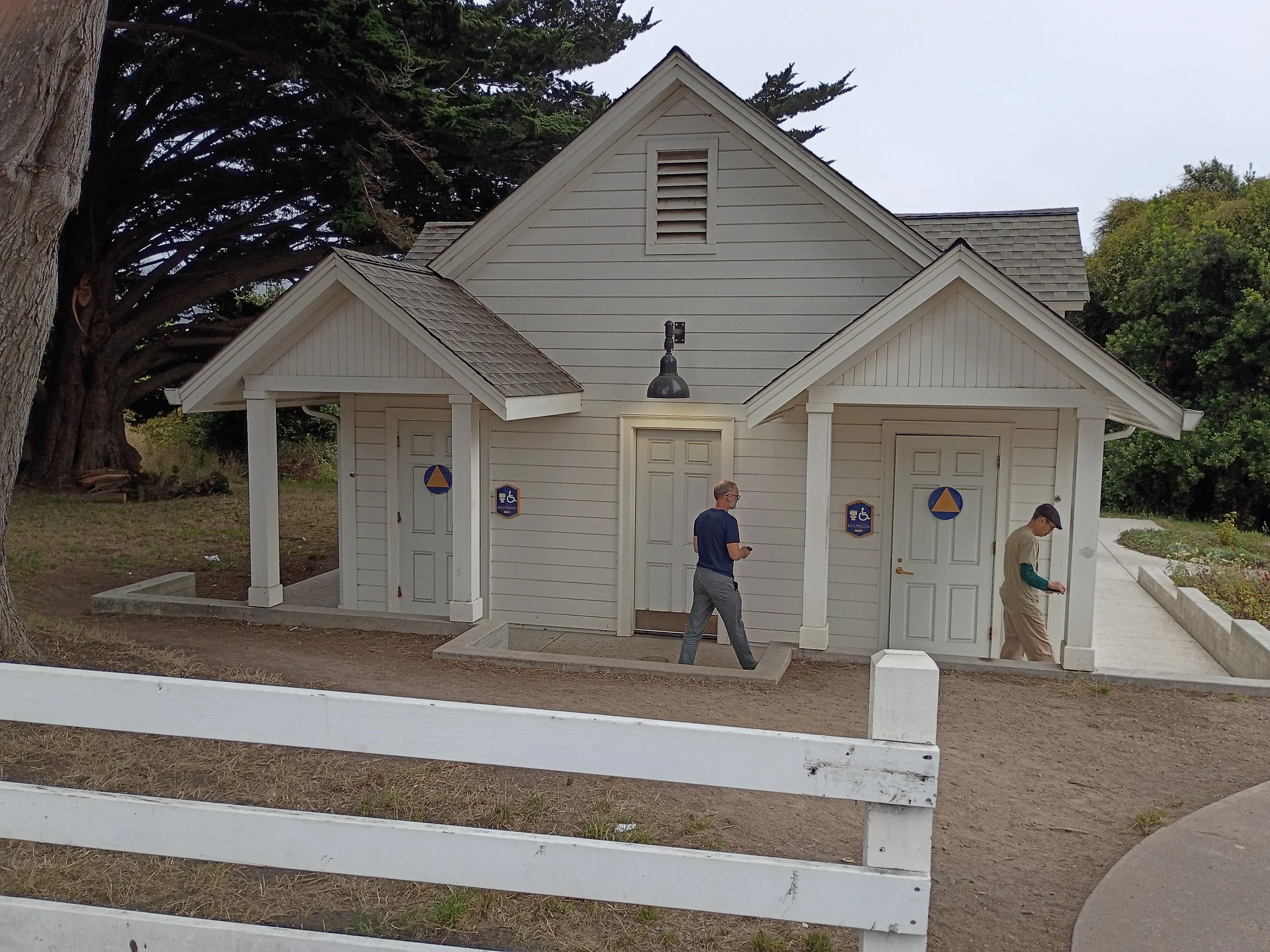
4 separate restrooms in one building designed to fit in with local architecture gets lots of use during the day, closed at night, makes visitors and residents comfortable and unanxious knowing they have a place to go. It is next to visitor/museum/gift shop building on edge of downtown.
During our visit to Mendocino, we stayed at the Little River Inn, explored the main tourist attractions, and made several observations. Mendocino has sustained itself through a strong tourism economy, with the town functioning as a living showcase of history, art, and personal services.
What can we learn from Mendocino to expand our tourism economy?
The key factors that make it successful seem to be:
· Retaining historic buildings with a storyline. New buildings just outside of downtown commercial area can be quite modern.
· A visitor center that funds itself with its gift shop filled with local art and manned by retirees trained in historical knowledge and culture.
· A public restroom in downtown next to visitor center that is clean and designed to fit in with the other buildings.
· There is angled parking along the two main streets where most of the shops and restaurants are located.
· Art Center with live theater in walking distance of entire town that supports a large local art community with many galleries to showcase their artwork along the walking corridors of two main streets.
· Shops filled with merchandise that is based on experiential exposure including local sourced clothes, bling, art and interesting goods in the bookstore and children’s exploration.
· Multiple restaurants with local organic food with diversity of types of service from easy going café and bakeries to white tablecloth tables. Clientele seem to be evenly split between tourists and locals. Home prices are much higher here with many residents enjoying a quite retirement.
· Regional tourism based on locally produced wine, beer, and cannabis
· Self-guided and docent led walking tours of homes, lumber industry, water towers, and nature along a bluff overlooking dramatic ocean shoreline.
· The location is just far enough away from urban populations for easy car and RV travel and there are many parks and scenic hikes along the coast nearby.
· The city has to manage a limited water supply with strict rules, but they make use of their historic water towers.
· Energy is brought in from mostly renewable sources of wind and geothermal. They are also building a battery storage facility (BESS) that will use new Iron-Air technology, rather than Lithium based batteries with purpose to fill the gaps when PGE shuts down transmission lines during hazardous events thus saving tourism trade.
· Transient Occupancy Tax (TOT) is over $8M/year and other taxes and fees total over $35M/year to support government services. The local businesses also get to thrive.
What can we do here in Petaluma?
We have much of this in Petaluma in our tourism trade but can always find ways to improve and reinforce. Storefronts are already shifting toward service, local goods and crafts. We have large mural art everywhere. We have a strong volunteer group doing walking tours starting at our museum. We can also survey the areas with most foot traffic potential and expand and improve this experience with filling in storefronts and vacant lots which is a project underway by the Know Before you Grow nonprofit. The most immediate action we can do is build a public restroom facility within the downtown area, which is in the works.
Here is a fuller report from Google CoPilot AI.
Tourism is the lifeblood of Mendocino’s economy, serving as its primary engine of commerce since the collapse of the local timber boom in the 1930s. This remote, picturesque Northern California region capitalizes on its isolated charm, dramatic coastline, and rich natural resources to draw nearly 1.8 million annual visitors. [1, 2, 3]
By transforming its historic assets into premium travel experiences, Mendocino has successfully insulated its local economy through diverse tourism sectors.
🏨 Hospitality and Direct Local Impact
The local economy relies heavily on Transient Occupancy Taxes (TOT) generated by overnight visitors. [1]
Boutique Lodging: Visitors stay in a mix of over 450 unique accommodations, including historic New England-style saltbox homes, Victorian inns, and luxury eco-resorts. [1, 2, 3]
Financial Cushion: Tourism spending directly offsets local household costs by injecting millions of dollars into public coffers, funding essential county services, infrastructure, and dedicated destination marketing. [1, 2]
Job Creation: Restaurants, local transportation, and niche tour groups directly sustain employment opportunities across the county's coastal and inland regions. [1, 2]
🍷 The 'Waves, Wines, and Weed' Trifecta
Mendocino thrives by layering distinct, high-value agricultural and lifestyle experiences. [1, 2]
Viticulture: With over 90 wineries spanning 10 American Viticultural Areas (AVAs), Mendocino holds the highest percentage of organic and biodynamic vineyards in the United States, attracting affluent eco-conscious wine travelers. [1]
Cannabis Tourism: Positioned within the legendary Emerald Triangle, the region actively markets licensed, sun-grown cannabis tours, boutique dispensaries, and consumption lounges like the Bohemian Chemist to capture a multi-billion-dollar niche market. [1, 2]
Culinary & Microbreweries: The region boasts celebrated microbreweries (e.g., North Coast Brewing Company) and fine dining options, including Michelin-starred farm-to-table experiences. [1, 2]
🌲 Eco-Tourism and Heritage Preservation
Mendocino monetizes its natural landscape and historic identity through well-maintained public attractions.
State Parklands: Visitors frequent 24 state and national parklands, exploring massive redwood groves, coastal trails, and pristine beaches. [1, 2]
Historic District Preservation: Named to the National Register of Historic Places, the village preserves 19th-century redwood buildings. This unique aesthetic protects it from generic modern commercialization, serving as a continuous draw for filmmakers, artists, and history enthusiasts. [1, 2]
Iconic Experiences: Historical draws like the Skunk Train and coastal rail bikes bridge the gap between heritage preservation and active outdoor recreation. [1]
🚗 Proximity to Major Urban Gateways
Mendocino capitalizes on its position relative to major northern California population centers. [1]
The 'Micro-Trip' Trend: Located roughly 114 miles north of San Francisco, the county markets heavily to urban weekenders seeking three-day getaways.
Targeted Regional Campaigns: Through agencies like Visit Mendocino County, the region optimizes its marketing budgets to sustain visitor volume during the traditional "shoulder seasons" (winter months), smoothing out economic dips. [1, 2, 3]
What are the tax revenues?
Mendocino County generates roughly $8.15 million annually in local tax revenue directly from its hotel and short-term rental market. This core funding is driven by two main visitor-facing lodging charges, which support both general public services and targeted destination marketing. [1]
The economic breakdown reveals exactly how these tourism dollars are collected and spent:
💰 The Transient Occupancy Tax (TOT) — $8.15 Million
The primary vehicle for tourism revenue is the Transient Occupancy Tax (TOT), commonly known as the hotel bed tax. [1]
The Rate: A 10% tax is levied on all lodging stays under 30 days in the unincorporated areas of the county. [1]
Where It Goes: Unlike some destinations that reinvest hotel taxes directly into tourism, Mendocino places 100% of these funds into the county's General Fund. []
Public Utility: This revenue stream is critical for balancing the county's budget, funding basic infrastructure, sheriff's deputies, public health initiatives, and road repairs. [1]
Historic Peak: TOT collections previously peaked at $8.4 million during the 2021-2022 travel boom before stabilizing at current levels. [1]
City Variants: Individual incorporated cities collect their own distinct TOT rates. For instance, the coastal hub of Fort Bragg increased its local TOT rate to 14%, and Ukiah collects a 13% rate. [1, 2]
📣 Business Improvement District (BID) Surcharge — $1.16 Million
Separate from county taxes, local lodging businesses vote to assess themselves an extra fee to fund regional marketing. [1]
The Surcharge: Guests pay a 1% assessment fee (roughly $2 on a $200 room) on lodging within unincorporated county limits.
Total Raised: This assessment pulls in approximately $1.16 million annually.
Funding Marketing: The county collects this money and contracts it out directly to the non-profit tourism bureau, Visit Mendocino County, to promote regional travel. [1, 2]
When combining state sales taxes, local gas taxes, and property taxes paid by commercial travel operators, tourism creates an overall regional impact of more than $46 million in combined state and local revenue, effectively offsetting significant tax burdens for permanent residents. [1]
What is Mendocino doing about water scarcity and energy production?
Mendocino County addresses water scarcity and energy production through localized utility planning, specialized infrastructure upgrades, and an expansion of eco-resilient renewable technologies.
Because the region lacks centralized infrastructure—the coastal village has no municipal water piping—mitigating resource constraints is critical to safeguarding both its residents and the lucrative tourism economy.
💧 What Mendocino is Doing About Water Scarcity
Historically vulnerable to severe droughts, Mendocino has shifted from emergency triage to long-term structural resilience.
Recycled Water Network Expansion: The Mendocino City Community Services District (MCCSD) launched a major infrastructure overhaul to install recycled water storage pipes. This network preserves up to 300,000 gallons of treated wastewater specifically for non-potable demands like fire protection and landscaping, safeguarding groundwater for drinking. [1]
Long-Term Policy Planning: In May 2025, the Board of Supervisors adopted the comprehensive Drought Resilience Plan (DRP). This plan established continuous hydrological monitoring across the county to handle future multi-year shortages. [1, 2]
Hospitality Mandates: To survive peak tourist seasons, hotels and restaurants deploy permanent conservation protocols. Local ordinances require restaurants to only serve water upon explicit request, and businesses use specialized water-tracking systems to prevent well failure. [1, 2, 3]
Private Tank Grants: The county coordinates state and federal financial assistance, including USDA Emergency Community Water Assistance Grants, to fund above-ground storage tanks for rural homes and travel providers. This allows businesses to store thousands of gallons of water during wetter winter months to blunt the impact of summer shortages. [1, 2, 3]
⚡ What Mendocino is Doing About Energy Production
To shield against wildfire-related blackouts and standard grid vulnerabilities, Mendocino has prioritized long-duration storage and decentralized energy partnerships.
The GeoZone Initiative: In partnership with Sonoma Clean Power, Mendocino County is developing the GeoZone. This initiative aims to scale up next-generation geothermal energy production, providing the region with reliable, 24/7 base-load renewable power that requires far less water than traditional extraction methods.
Industrial Scale Storage: To capture excess solar and wind power, California’s largest long-duration battery facility is positioned at a local substation. This 5-MW/500-MWh iron-air battery project can discharge energy into the local power grid for up to 100 consecutive hours during severe weather lulls or wildfire blackouts.
Private and Tribal Microgrids: Agricultural operators and localized sovereign communities are actively moving off-grid. Major regional wineries (like Roederer Estate and Scharffenberger Cellars) have implemented solar-and-saltwater battery microgrids to keep operations running during rolling blackouts. Concurrently, local tribes, like the Guidiville Rancheria, utilize private financing to construct solar-powered microgrids to secure residential energy independence.
Decommissioning the Potter Valley Project: The region is navigating a massive utility shift as PG&E decommissions the century-old Potter Valley Hydropower Project. This removal of two dams on the Eel River requires the county to diversify its regional energy footprint away from legacy hydro-generation and transition toward microgrid networks. [1, 2, 3, 4, 5]
A multi-day iron-air (Fe-air) battery storage facility is actively underway for Mendocino County. Developed by energy storage innovator Form Energy, this facility represents California's largest long-duration energy storage project and the first of its kind in the state. [1, 2, 3]
The key details of this upcoming infrastructure project include:
The Location: The battery modules are being installed next to a Pacific Gas and Electric Company (PG&E) substation right within Mendocino County. [1, 2]
The Capacity: The modular field is a 5-megawatt (MW) system designed to provide a massive 500 megawatt-hours (MWh) of storage capacity. This is enough power to support roughly 1,500 local homes for up to four consecutive days. [1, 2]
Timeline: The project was kickstarted by a $30 million grant from the California Energy Commission (CEC). Deployment began in mid-2025 with full grid-integration scheduled for early 2026. [1, 2, 3, 4]
Substation Constraints: The facility's footprint was intentionally scaled to 5 MW to perfectly align with the specific charging capacity limitations of Mendocino's rural substation. []
🔋 How the "Rust Battery" Protects the Local Grid
Unlike standard lithium-ion commercial grid batteries that generally max out at 4 hours of discharge time, this Fe-air system can continuously dump power back into Mendocino's grid for 100 to 150 hours. [, 3]
The Chemistry of Reversible Rusting: The battery cells contain a nonflammable, water-based electrolyte solution packed between iron and air electrodes. When discharging, it breathes in oxygen, converting the metallic iron into rust and generating electricity. To recharge, the electric current is reversed, converting the rust back into pure iron and expelling oxygen.
Weather and Wildfire Mitigation: This 4-day discharge window is deliberately timed to match the duration of major coastal weather fronts and wildfire-related Public Safety Power Shutoffs (PSPS). It captures excess regional solar and wind power during low-demand periods and serves as a long-term safety net during multi-day grid lulls.
Sustaining Tourism Commerce: By bridging these long blackout gaps, the project aims to keep coastal hotels, shops, and restaurants fully powered, preventing the multi-day regional business closures that historically cost the local tourism industry millions in lost revenue. [1, 2, 3, 4]
